Major breakthrough: the end of botox animal testing moves closer
- News
The European Directorate for the Quality of Medicines & HealthCare (EDQM) has announced a landmark decision to phase out the cruel mouse LD50 test for botulinum toxin from the European Pharmacopoeia. This move brings closer the long-sought end to one of the most severe animal experiments still required for medicine quality control in Europe. The European Coalition to End Animal Experiments (ECEAE) warmly welcomes this long-overdue step, which reflects nearly two decades of sustained campaigning by our coalition and our member organisations across Europe.
Botulinum toxin, widely known as botox, is used medically for conditions such as eyelid spasms and certain movement disorders, but is most commonly used for aesthetic wrinkle treatment. For botox quality control, mice are still exposed to varying doses of this highly toxic nerve agent. The animals suffer paralysis and breathing difficulties, with many dying an agonising death by suffocation. Under EU law, this so-called LD50 test (the dose lethal to 50% of the animals) is classified as a procedure of the highest severity level. Reliable, animal-free cell-based testing methods have been available for years.
The EDQM and the European Pharmacopoeia Commission have now decided to reconvene their working group on botulinum toxin. This group will develop a roadmap for phasing out the LD50 test for botox and revise the relevant texts of the European Pharmacopoeia accordingly. However, the announcement does not yet include any timeline or concrete deadlines for this process.
"We are delighted by the EDQM's clear commitment to finally phasing out the cruel LD50 tests for botox," said Dr Dilyana Filipova, Deputy Chair of the ECEAE. "What matters now is that the announced roadmap is developed swiftly and includes binding deadlines that take effect in the short term. These tests must be brought to a complete end as quickly as possible."
ECEAE has campaigned for an end to cruel botox animal testing since 2009, working to raise awareness of the issue across Europe. Over the years, ECEAE has taken part in numerous discussions with experts and regulators, while ECEAE's member organisations have informed the public in countries throughout Europe about the reality of botox testing. This sustained pressure has contributed to major botox manufacturers developing and implementing animal-free tests for their products.
In 2023, ECEAE submitted more than 164,000 signatures from across Europe to the European Medicines Agency (EMA), prompting the EMA to place the issue on its agenda and carry out a detailed analysis of the situation. This year, ECEAE launched a renewed campaign, "Stop Botox Animal Testing!", once again calling for an end to these tests. In early June, ECEAE also sent a formal letter to the EDQM demanding an end to botox animal testing.
"Our persistent work and the pressure of hundreds of thousands of supporters have helped ensure this issue can no longer be ignored," said Dr Filipova. "This is a genuinely positive step, and it shows that our efforts are paying off. We will continue to monitor developments closely and keep pushing for a complete and immediate end to these tests."
There is still a lack of transparency about how many mice are used for botox testing each year, for what specific purposes, and by which companies. ECEAE will continue to campaign for full transparency alongside the complete abolition of the LD50 test.
Reference
First rabbits, now mice: the European Pharmacopoeia turns its attention to phasing out the mouse LD50 assay from its monographs on botulinum toxin. EDQM, press release, 07.08.2026
Your help is needed!
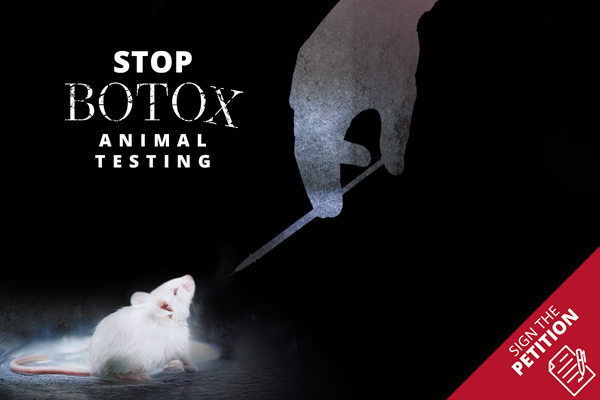
Let’s stop botox animal testing once and for all - sign our petition today!