Stop the Suffering of Horseshoe Crabs - signatures handover in Amsterdam
- News
Almost 34,000 signatures handed over to the European Medicines Agency (EMA)
Horseshoe crabs are ancient animals that are captured by the hundreds of thousands to collect their blue blood. It is used for medical tests, even though animal-free methods have existed for decades. To help end the use of horseshoe crab blood, the European Coalition to End Animal Experiments (ECEAE), today handed over 33,849 signatures to the European Medicines Agency (EMA) in Amsterdam. The goal of the petition is to delete the animal-based test from the European Pharmacopoeia, the rulebook for quality control testing in Europe.
It is estimated that every year, around 550,000 horseshoe crabs are caught off the east coast of the United States and transported to laboratories, where one third of their blue blood is drawn without anesthesia. About 150,000 of them die during the procedure. The others are released back into the sea, but little is known about long-term effects or how many more die afterward.
The Limulus amoebocyte lysate (LAL) test, based on the blood of horseshoe crabs, can detect so-called pyrogens in infusion solutions and vaccines. These are dangerous substances that can cause fever in humans and therefore must be excluded. Until recently, the rabbit pyrogen test was the standard for this purpose. In this test, the test substance is injected into the rabbits’ ear vein, and it is then measured whether their body temperature rises. More than 17,000 rabbits were used each year in the European Union for this purpose and were killed afterward. This test was removed from the European Pharmacopoeia in July 2025, 15 years after the approval of its animal-free alternative.
ECEAE demands that the LAL test is now also removed from these regulations. Animal-free methods for both tests have long been available: the MAT test, which is based on human blood, and the rFC test, which synthetically replicates components from horseshoe crab blood. The rFC test has been available for around 25 years and has been accepted in the European Pharmacopoeia since 2016. It provides more accurate results than the animal-based test. But as long as the LAL test remains permitted, it will continue to be used.
The European Medicines Agency (EMA) in Amsterdam is the authority overseeing the authorisation of medicinal products. They have a role to play in which Pharmacopoeia methods are used to test the safety of these medicines. Representatives from the EMA met with the petition owners and explained in what way they can help.
ECEAE Chair Dr Tamara Zietek, who led the delegation of ECEAE representatives in Amsterdam said: “It is completely incomprehensible why a test associated with so much animal suffering is still allowed, even though there have long been regulatory accepted, animal-free and even superior methods. In the case of the rabbit test, it took 15 years from the approval of the animal-free method until the animal test was removed. The authorities must act now to end the use of horseshoe crab blood for good.”
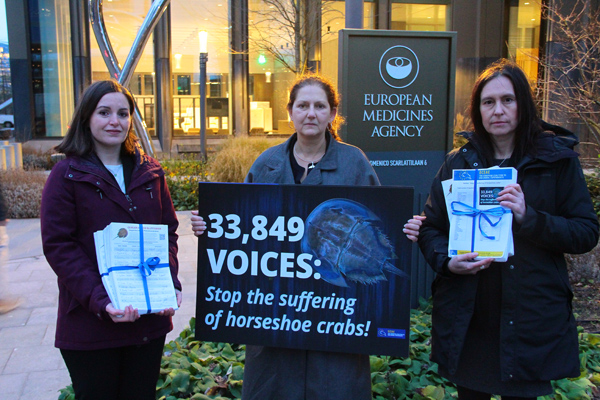
The ECEAE delegation in front of the EMA in Amsterdam (from left): Dr Dilyana Filipova, Susan Hartland, Dr Tamara Zietek.
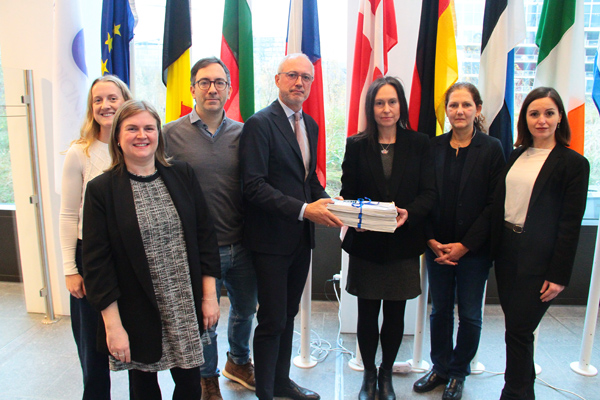
The EMA representatives (left) accepting the signatures from the ECEAE delegation.
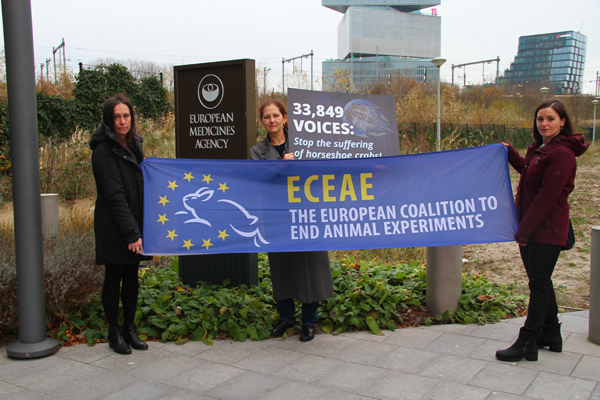
The ECEAE delegation outside the EMA in Amsterdam.